
The Strategic Advantage of Self-Performing Concrete in Commercial Builds
In commercial and industrial development, no single structural element carries as much weight literally and financially as concrete. From the subterranean footings bearing the structure’s weight to high-traffic slab-on-grade floors, concrete serves as the physical backbone of operational performance.
Yet, for many developers and project managers across Sioux Falls, Rapid City, and the wider Midwest, concrete is often treated as a standard commodity. In reality, how a contractor approaches concrete execution directly determines whether a building becomes a low-maintenance operational asset or a source of ongoing maintenance headaches.
Here is a look at how an advanced, self-performing approach like the one utilized by Raeco Builders redefines quality, speed, and return on investment in commercial concrete construction.
The Strategic Advantage of Self-Performing Concrete
The traditional commercial construction model relies heavily on tiered subcontracting. A general contractor bids out the concrete package, leading to third-party crews managing excavation, rebar, pouring, and finishing under separate supervision.
When a builder self-performs concrete services, that fragmented chain of command vanishes.
Direct Quality Oversight: In-house crews manage every phase from initial site excavation and formwork placement to placement, finishing, and curing.
Streamlined Scheduling: Eliminating third-party subcontractor availability conflicts gives the builder total control over pour dates and weather windows.
Unified Accountability: Single-source responsibility ensures that foundation dimensions and bolt placement match engineering blueprints down to the millimeter.

Tech-Driven Precision
Modern commercial facilities—particularly distribution centers, manufacturing plants, and heavy equipment bays require exceptionally flat, level, and durable surfaces. Achieving these specs requires moving past manual labor techniques and investing in advanced site technology.
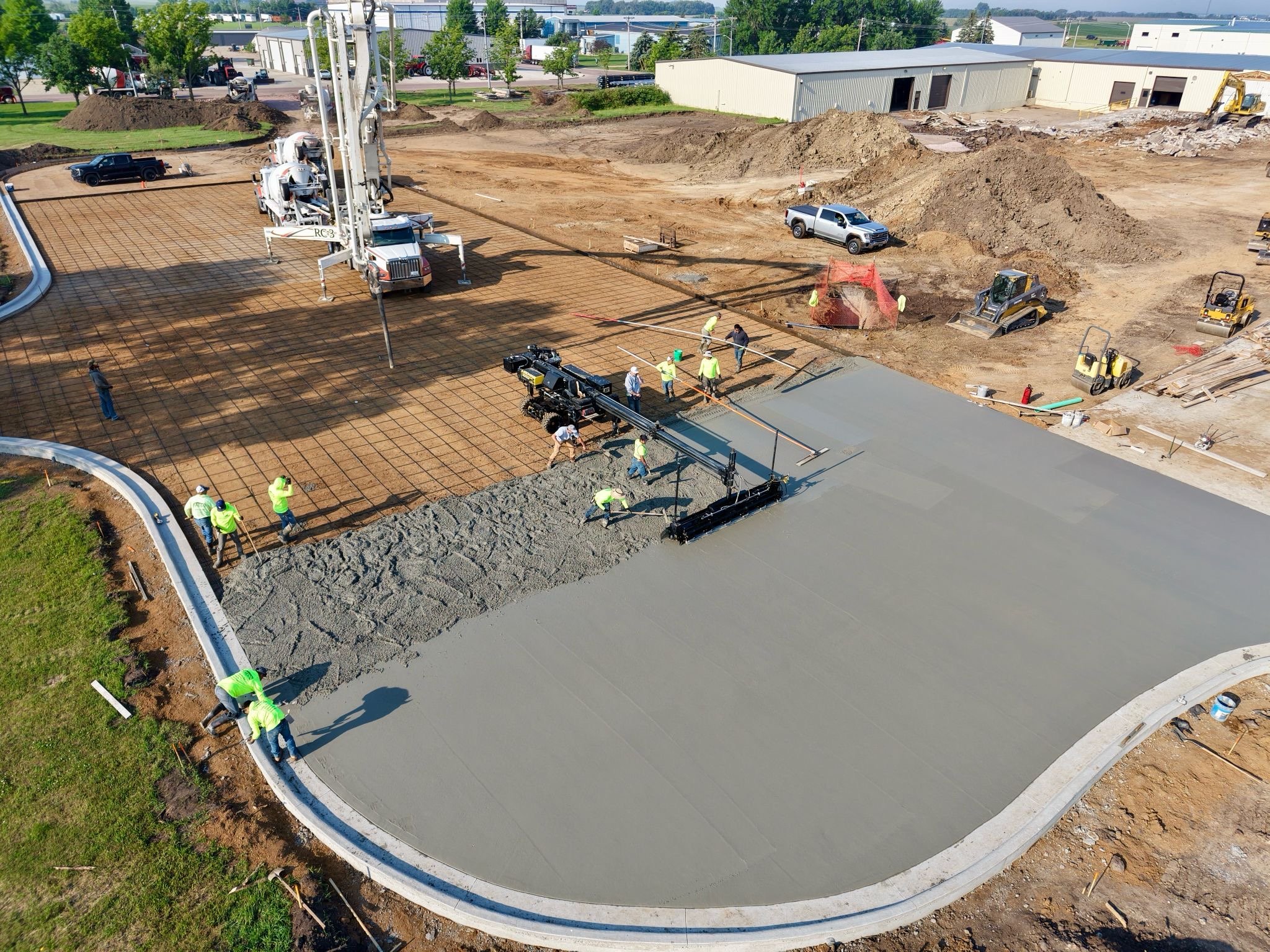
By deploying tools like 3D GPS imaging, robotic total stations, and laser screeds, field teams can fundamentally eliminate human error:
Robotic Layouts: Digital site modeling ensures excavation and footing alignments are accurate to fractional tolerances.
Automated Surface Levelling: Laser-guided screeds flatten concrete in real time during placement, creating exceptionally tight surface tolerances (FF and FL numbers) impossible to replicate by hand.
Consistency Across Massive Acreage: Whether pouring a high-density interior slab or an exterior heavy-use pad, digital automation ensures uniform thickness and structural integrity.
Speed, ROI, and the Concrete-over-Asphalt Shift
Time on a construction site is directly tied to capital costs. Advanced equipment combined with unified, experienced crews allows large-scale pours that used to take days to be completed in hours.
This field efficiency yields a major financial benefit for project owners, particularly when planning exterior hardscaping and parking facilities:
Lower Labor Hours: Accelerated pour times drastically reduce job-site labor overhead.
Long-Term Cost Parity: Higher field efficiency allows durable concrete paving to compete closely with traditional asphalt on initial installation costs.
Lifecycle Savings: Unlike asphalt, which requires frequent sealcoating and resurfacing, concrete offers a decades-long service life with minimal maintenance—delivering a significantly lower Total Cost of Ownership (TCO).
Building a Foundation for Long-Term Value
In commercial construction, the foundation sets the standard for everything built on top of it. By prioritizing self-performed execution, cutting-edge levelling technology, and rigorous site control, project owners ensure their facility is built on a bedrock of precision and lasting strength.
When planning your next commercial development, partner with a builder who treats concrete as a core engineering discipline not an outsourced afterthought.